
A summer from hell?
But still plenty of UV to burn here first ....
Updated 5 Feb 2025 to better explain the plots of daily doses.
My colleague James Renwick’s recent article in The Conversation explains why the weather has been so unsettled in New Zealand this summer, causing a trail of destruction including several deaths. It’s due to a range of factors including Climate Change - so more of the same can be expected in the future.
The Central Otago region - where I live - was less affected, but still abnormally unsettled. Despite that, there was still plenty of sunburning UV about. Plenty to cause a lifetime of skin damage and even death. Apparently, more than half of New Zealand’s GenZeders (aged less than 30) deliberately go out on high UV days to get a tan. It’s so stupid.
On those sunniest days, the UVI can be more than 12, and the daily dose of sunburning UV sometimes exceeds 70 ‘Standard Erythemal Doses’ (SED), which is thirty times more than enough to cause skin damage for people who think they need to tan. To put it another way, even if a sunscreen of SPF 30 were correctly applied all day long, there’d still be measurable skin damage.
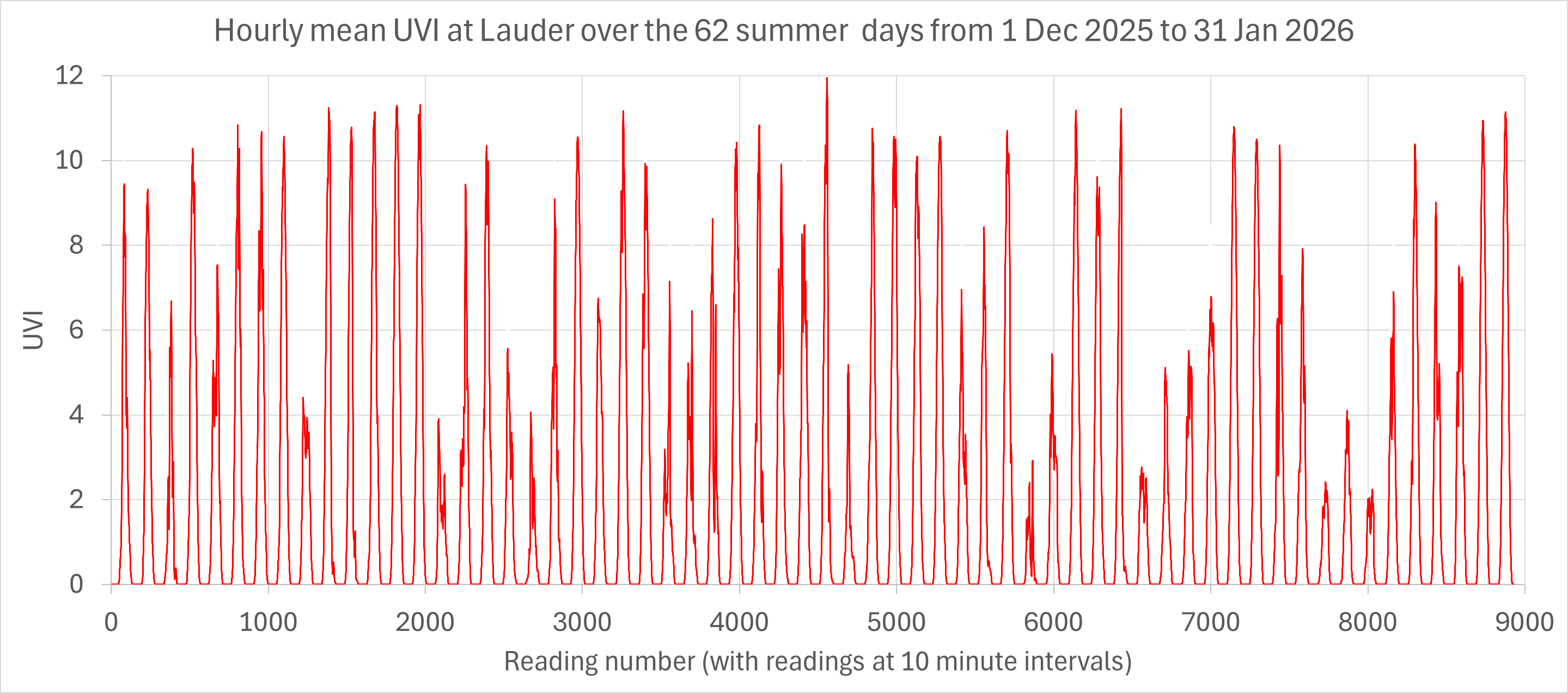
The hourly-averaged measured UVI at Lauder over the two-month (62 day) period from 1 December 2025 to 31 January 2026 is shown below. The year roll-over is marked by highest value this summer, UVI = 12, which occurred around noon on the first day of 2026. At that time, skin damage could occur in less than 15 minutes. On this partly cloudy day, the peak 10-minute value reached 13.5, which is higher than the expected clear-sky value. But that wasn’t sustained over the full hour and was balanced by lower values when clouds blocked the sun. There were fewer than 10 perfectly cloudless days over the entire period - recognizable by the symmetrical diurnal pattern. There were also weekly intrusions of bad weather with a lot of cloudy days, but only three when the UVI didn’t exceed the ‘Alert’ level of 3. It was potentially damaging just about every day. The peak hourly UVI exceeded the ‘Extreme’ level (UVI > 10.5) on about a third of of the days.
But it’s the UV dose over minutes or hours that matters. The corresponding daily doses of sunburning UV - as it accumulates each day - are shown below. As you can see, they range from 11 to 68 SED per day, with an an average over the period of 45 SED. Note that the peak dose on (13 December) was much greater than on the day with the peak UVI (1 January), which was cloudier in the afternoon. For fair skinned people, just 2 SED is enough to cause skin damage (as evidenced by skin reddening), so even the lowest UV day (10 January), the dose was more than enough to cause sunburn.
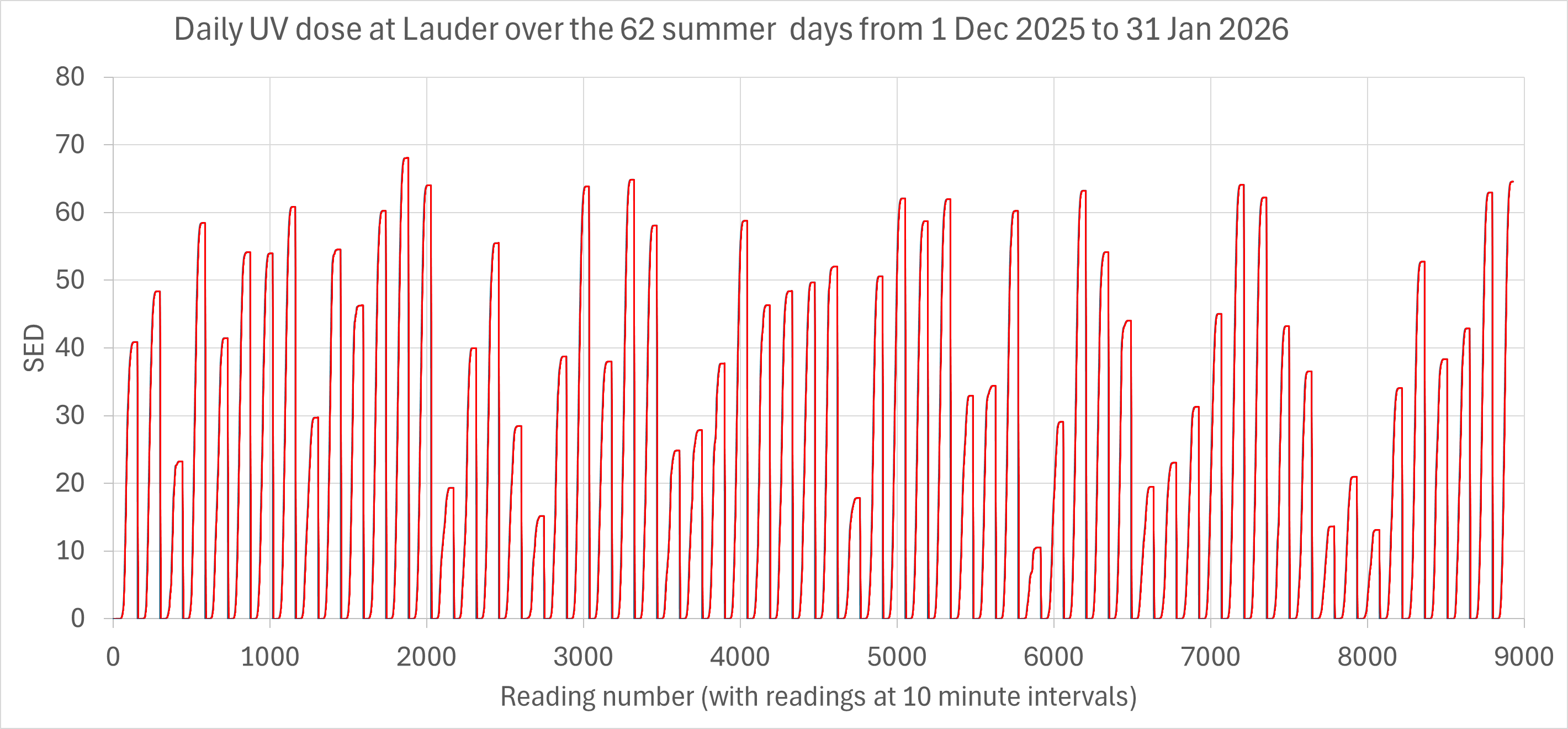
The accumulated sunburning dose over the entire period reached a staggering total of 2775 SED. That’s enough for nearly 1400 harmful doses.
The New Zealand summer school holiday period runs from mid-December to the end of Jan. It varies a bit from school to school, but for my grand-kids I think it was from Saturday 13 December 2025 ‘til Sun 1 Feb 2026. Over that 7-week summer period, the total UV dose at Lauder (45S) was 2200 SED, enough for more than 1000 bouts of skin damage for fair-skinned people should they choose to spend most of the daylight hours outdoors without protection.
Although the summer was cooler and less settled than usual, in terms of its ability to burn it could still be described as a summer from hell. Those youthful sun worshippers would be well advised to take note. Although they might feel bulletproof at their stage of life, things look rather different from my end of the life cycle. I personally know many who’ve had melanomas removed; and knew several who’ve died from it. Off the top of my head the latter include my old school friend Paul Ackerley, my old boss and colleague Gordon Keys, and a couple of rellies Mike Hattie (my brother-in-law) and Wally Lynch (my wife’s uncle).

UV levels are highest when the sun is highest in the sky, so they show a strong seasonal variation, with a maximum near the summer solstice. At the winter solstice, UV levels in the north of New Zealand levels are less than 20 percent of their summer peaks, while in the south they are less than 10 percent of their summer peaks. On sunny days, the UVI is strongly peaked to the solar noon period, which is between 1 and 2 pm in NZ summer time, when it tends to be about 20 percent greater in the far north of the country compared with the far south. For similar sun elevation angles, the UVI is typically larger in autumn when ozone amounts are smaller than average compared with in spring when ozone amounts are larger.
Some knowledge of the potential damage from UV is needed. And I don’t think so-called ‘Influencers’ will be the ones to provide it. You can’t directly sense UV either. Although it tends to be more intense on warm days, it’s not proportional to temperature. The UV apps that my friend Jerry Burke and I developed were designed to fill that void in knowledge for the great unwashed. You can also get UV forecasts from the internet (e.g., TEMIS), Amazon’s Alexa, or from the iPhone weather app.
But how well do they perform? To answer that, I manually recorded the peak UVI predicted for Lauder from several different sources over the summer holiday period and compared results with the measurements shown above. I’ll show the results next time.
A like really isn’t appropriate. More like, wow.