High noon for UV
Why it matters ...
You may have noticed my care in saying that UV is highest UV at ‘solar noon’, rather than simply at ‘noon’. There’s a good reason for that care.
The question is: when is noon not noon?
which reminds me of the old chestnut riddle:
Q. When is a duck not a duck?
A. When one of its legs is both the same.
The answer (to the noon question) is, hardly ever. In fact, in the New Zealand summer high noon is never at clock noon. Our clocks are referenced to longitude 180°, which is well to the East of New Zealand. By the time you add in the one hour of summer daylight saving, high noon occurs much later.
The next question is: how much later?
It’s an important question because the time of highest sun elevation (or lowest solar zenith angle) is what determines the time of maximum UV radiation, which follows because the UV will be most intense when its path-length through the atmosphere is minimised.
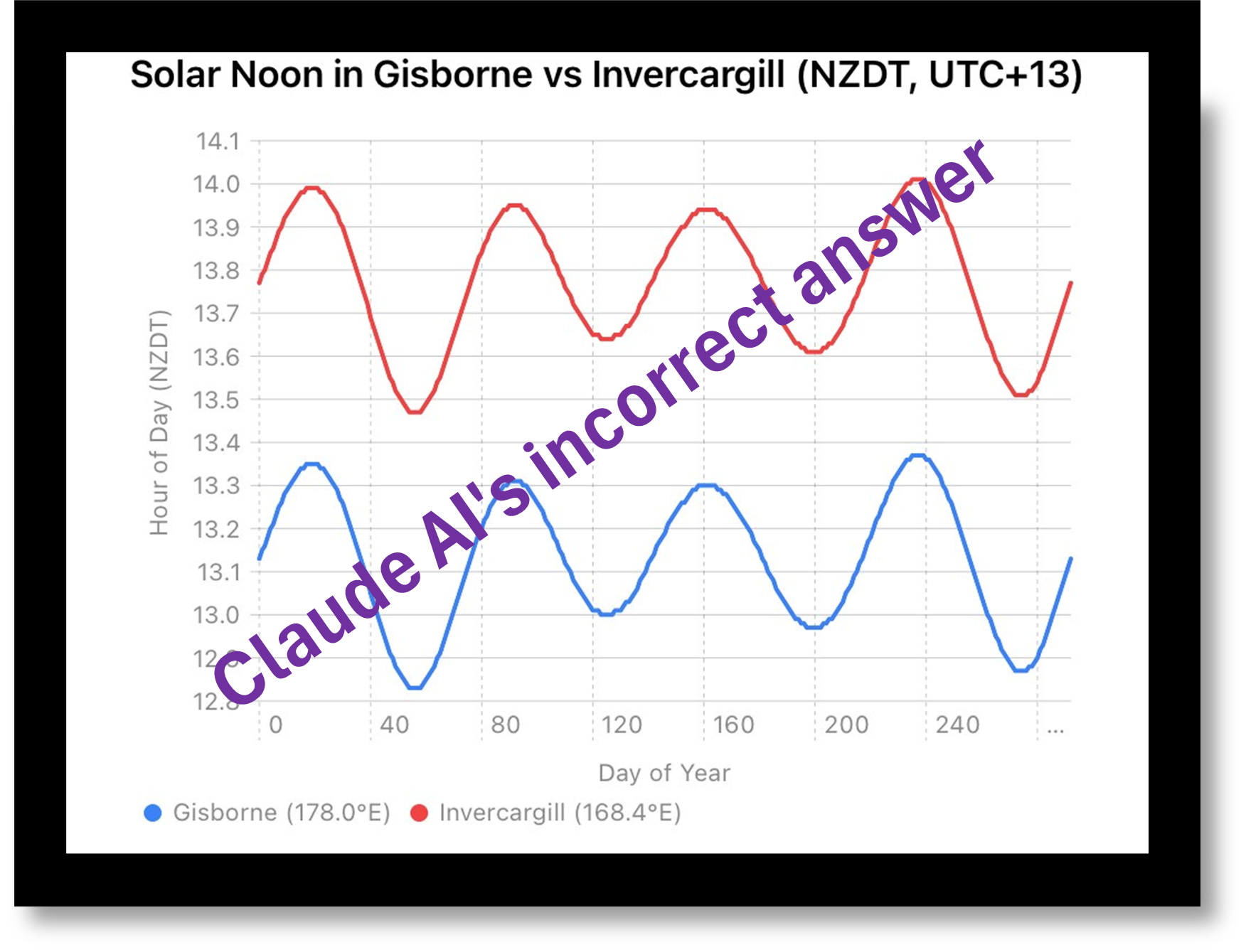
With a bit of prompting after a few false starts, my free AI assistant (Claude, Sonnet 4.6) helped produce a graph which at first sight, it looked plausible but unfortunately was not correct. The range of offsets in time looked about right, but there were 4 cycles over the year instead of the two I expected. In case you’re interested, I’ve included a suitably annotated version of Claude’s plot at the end of this post. When I questioned Claude further, it came back with the not-very-helpful message “Claude can make mistakes. Please double-check responses”.
After double-checking it out with my colleague, Ben Liley, and finding it was indeed in error, I persuaded him to provide his correct version of the plot. He’d just made a start on it when I decided to try asking the same question of the paid version of Microsoft’s Copilot AI tool, that’s available through their Edge web-browser on my work laptop. Ben’s a highly proficient programmer, but sadly for him (he’s a mere mortal after all), the AI tool won the race.
The answer to the question is, a LOT later!!
Here’s Copilot’s result (which agreed perfectly with Ben’s). It shows the time of highest sun (high noon - or solar noon) each day for Invercargill (168.4°E, blue) and Gisborne (170.8°E, red), the Westernmost and Easternmost cities in New Zealand.
The time scale used is the same as on your clock or watch, so the dominating features are the 1-hour steps around day 90 and day 270 which correspond to the switches from New Zealand Daylight-savings Time (NZDT) at the end of summer to New Zealand Standard Time (NZST), and the switch back the summer time in spring.
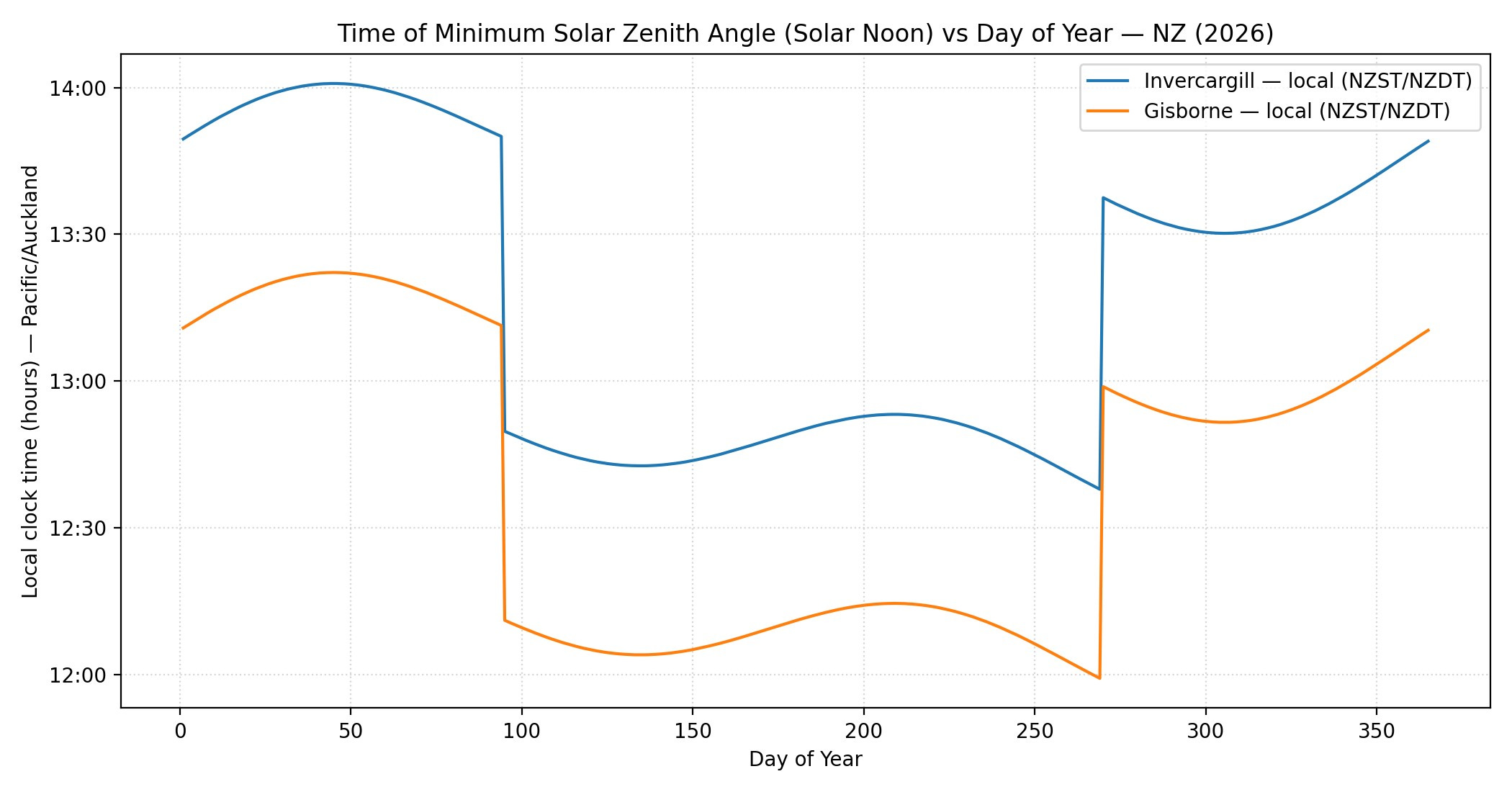
The largest offsets of solar noon compared with clock-time noon occur at Invercargill around day 50 (around 20 February), when overhead sun occurs just after 2 pm: a full two hours after noon on your clock or watch. On no summer day is it earlier than 1:30 pm at this site.
It takes 24 hours for Earth to spin though 360 degrees (or 15 degrees/hour), so solar noon at Gisborne, our Easternmost city, occurs about 40 minutes earlier (corresponding to that 12.4-degree difference in longitude). There, the corresponding solar-noon times range from12:50 to 1:20 pm in summer. In New Zealand, it’s only at these Easternmost areas for a short period just before the switch to summer time (around day 270) that the time of highest sun ever corresponds to clock noon.
The smoother variations in those curves arise because of the ellipticity of Earth’s orbit about the Sun and the tilt of its spin axis. They’re called the ‘equation of time’ variations, with have a range of about ±16 minutes.
Gisborne’s latitude is 38.7°S compared with Invercargill’s 46.4°S. That difference means that its highest daily sun elevation are 7.7 degrees higher than Invercargill’s. The shorter resulting path-length of the Sun’s rays though the atmosphere means that, as well as the UVI peaking earlier in Gisborne, its maximum for clear-sky conditions is also greater (despite its slightly higher ozone amount that day), as shown below.
On 1 January, the calculated peak UVI at Gisborne was 11 percent higher, reaching 11.4 at 1:10 pm compared with Invercargill’s 10.3 at 1:50 pm . Interestingly though, because of Invercargill’s longer daylight hours, its daily dose of UV was only 6 percent less (with 63 SED of sunburning UV at Invercargill compared with 67 SED at Gisborne).
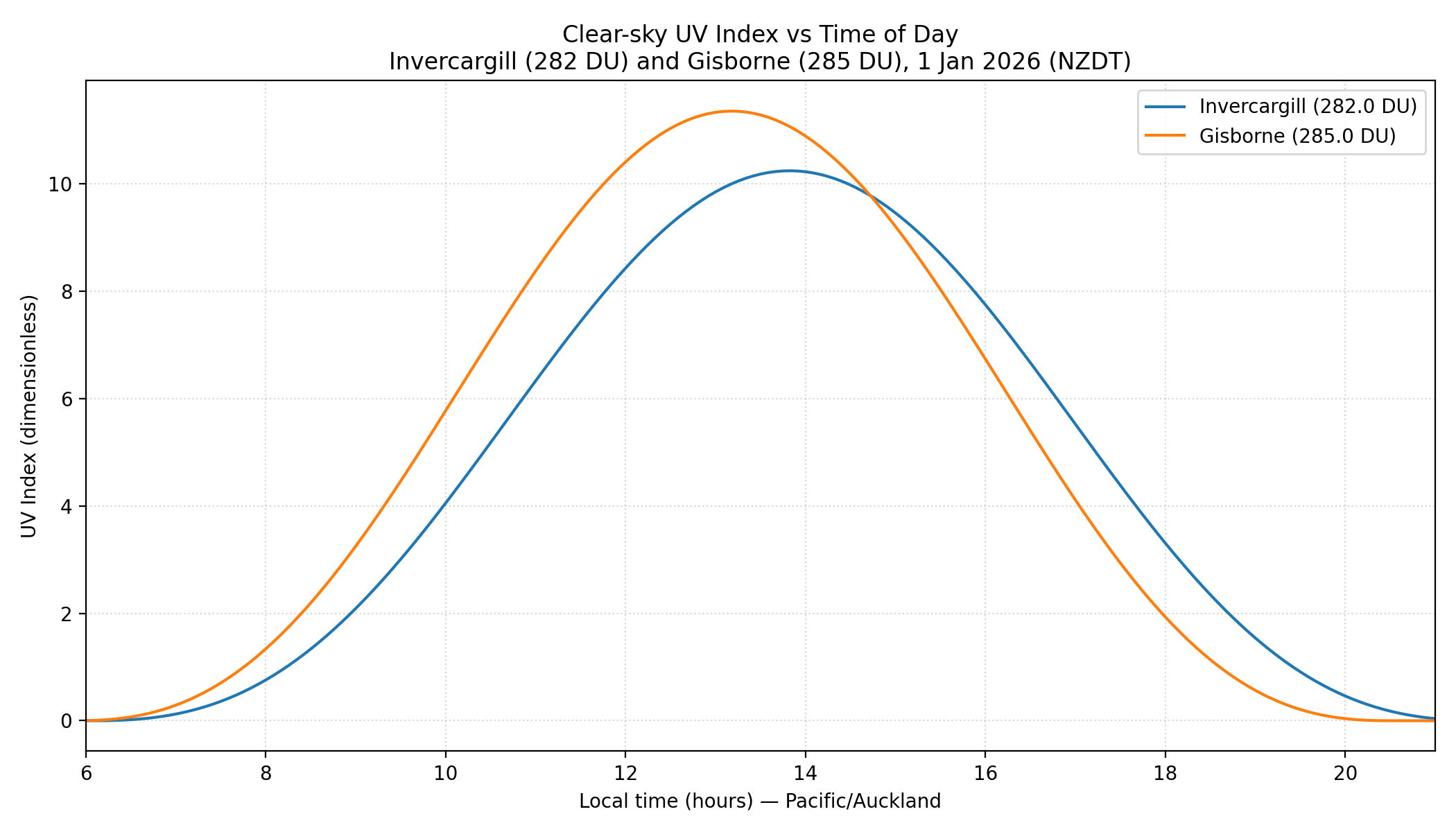
As I’ve harped on about before, the danger time in the NZ summer is therefore from around 11:30 am to 4 pm. That’s from two hours before solar noon in the East to two hours after solar noon in the West.
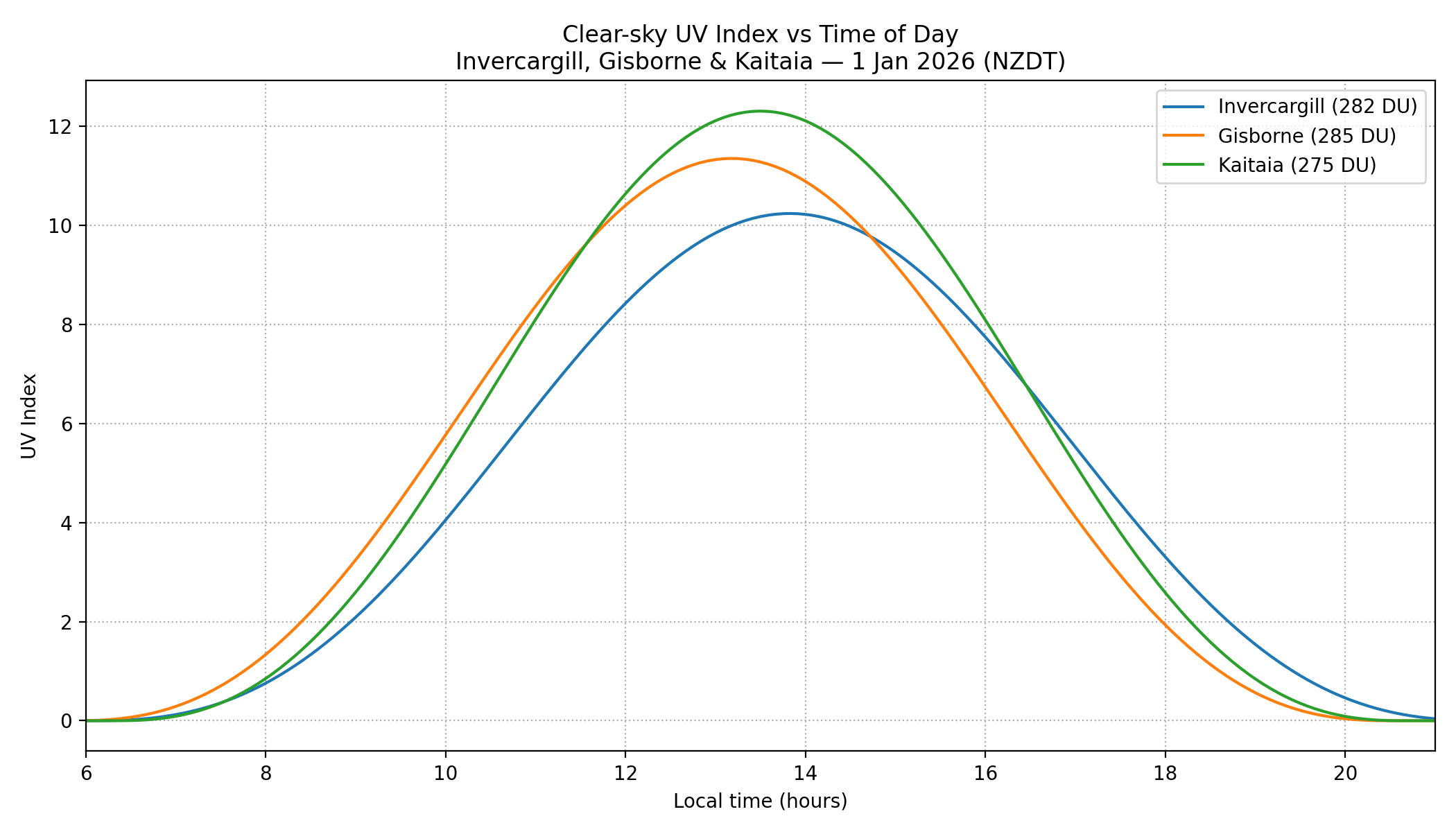
Just for completeness, in the version below I’ve included New Zealand’s Northernmost city, Kaitaia (35°S, 170°E). Since Invercargill is also the Southernmost city (in addition to being the Westernmost), this shows the full range of clear-sky variability of UVI throughout the country this day.
The time offsets between clock noon and solar noon are relatively large for New Zealand, but they’re hardly ever zero anywhere in the world.
Bonus (or should that be bogus?) material
Claude AI’s wrong answer. Luckily the error make little difference in practical terms.
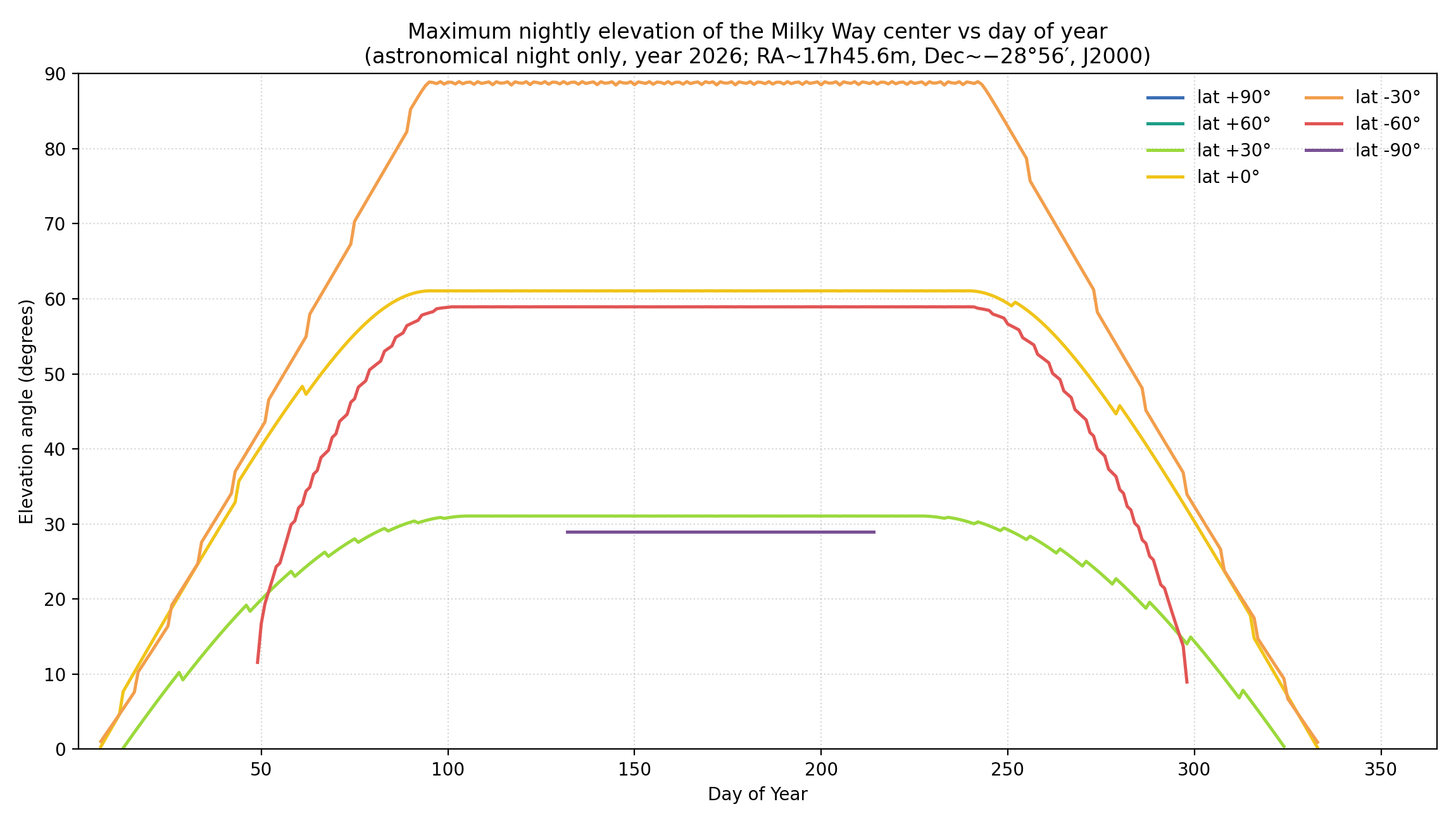
Seeing this error made me suspicious about Claude’s previous calculation of the elevation angle of the centre of the Milky Way. That too seemed to have too many turning points for my liking (which is why I ran it past a couple of experts before posting). Here’s the update using Copilot. I haven’t plotted exactly the same quantities, but the overall result looks consistent with the earlier plots. The main point was that southern mid-latitudes - including New Zealand - are the best place to view the Milky Way. Patterns are essentially the same each year.