
Time to say 'when'
for outdoor pursuits ...
In my recent ramblings about UV over the summer months, I showed a plot of how the skin-damaging UV accumulates each day at nearby Lauder (45S, 170E) .
The day with the most UV over that period was Saturday December 13, about one week short of the summer solstice. The plot below shows in detail how the UVI varied over the course of that day.
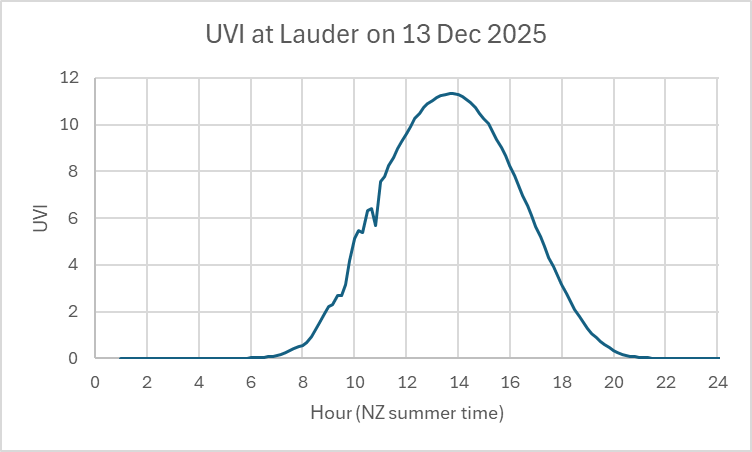
As you can see, there were a few scattered clouds in the morning between 9 and 11 am, but symmetry shows that they had only a slight effect on the UVI. It looks like the sky was entirely cloud-free from 11 am until sunset. The peak occurred shortly before 2 pm New Zealand summer time (which includes an hour of ‘daylight saving’). Daily maxima occur up to 40 minutes earlier in more eastern parts of the country.
The maximum UVI this day was about 11.5, but it’s the dose of sunburning UV that matters. A high UVI for an instant won’t hurt you. It’s the accumulation over time that does. That dose is usually expressed in terms of the number of Standard Erythemal Doses (shortened to SEDs), which means the standard dose for the- reddening of the skin by sunlight.
The number of SEDs to cause the first signs of skin reddening - which indicates skin damage - depends on your skin type. For the fairest skins it might take only 2 SEDs, while for the darkest it will be more than 15 SEDs. If you’re somewhere in between but think you’d look better with a tan, the number is probably less than 3 SEDs.
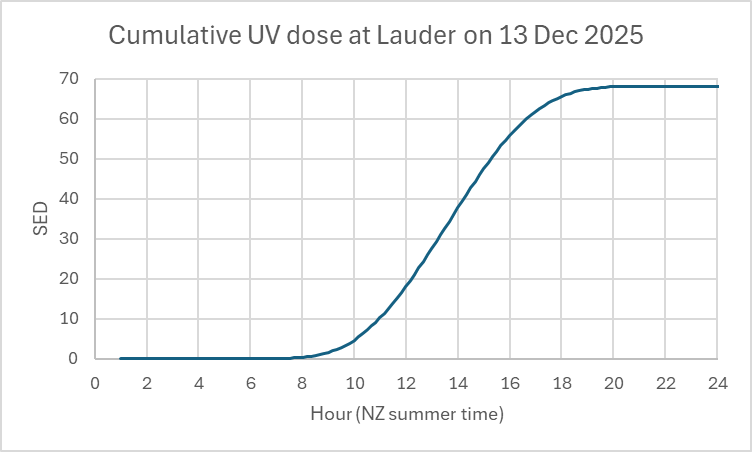
The plot below shows a close-up of how the skin damaging dose of UV dose built up over that single day. As you can see, it far exceeds that threshold for safe exposure. Over the full day, there’s 30 times the safe exposure limit for the most sensitive skin type and at least 20 times too much for most would-be sunbathers. Clearly, protection would have be needed to avoid skin damage.
There are some simple useful take-home messages there.
The periods with the most rapid increase in UV dose are the ones to be avoided. That’s the period centred near 2 pm this day. For those UVI levels - near 12 - you can get about 10 SEDs per hour. That’s five skin-reddening doses each hour for fair skin, or one dose every 12 minutes! A good rule of thumb is to avoid exposure within a couple of hours either side of that peak time. In other words, avoid sun exposure between noon and 4 pm. If you did that on this day, the total exposure would be no more than 30 SED. Still a dangerous amount, but a lot better than the 68 SED for the entire day. At the other end of the scale, it shows that you’re pretty safe before 8 am and after 8 pm. Not many get sunburnt at night! (or during twilight, or even if the sun is less than thirty degrees above the horizon).
In retrospect, I’m glad I chose not to play golf that day. The Saturday competition times at our local golf club - with tee-offs starting around noon - couldn’t be worse as far as UV exposure is concerned. In any case, I’m much happier playing any outdoor sport in the early mornings, or late evenings. To keep the dose below 10 SEDs that day, I’d have to be finished by 11 am, or start after 4 pm. At other times of the year, those limits can be relaxed. In either case, there are always plenty of daylight hours available here to complete the round under low UV conditions. My personal preference is to play in the mornings. Even though the changing dew conditions may make putting more difficult, there’s usually less wind and it’s much cooler too.
And I still wear a hat and apply sunscreen.
‘What about me?’, you might say. That’s just one place and time.
The answer’s at your fingertips. You can get personalised advice to plan your outdoor activities wherever you live for any day of the year by consulting one of our free smartphone apps:
GlobalUV (which works anywhere in the world), or
UVNZ (for New Zealand only).
Go get one!
Extra, in case you’re still craving for more …
The above plots were for the day this summer with the highest daily dose of skin damaging. Below are the corresponding plots for the day with the highest peak UVI, 1 Jan 2026. As expected, it’s also close to the summer solstice; this time 10 days after it.
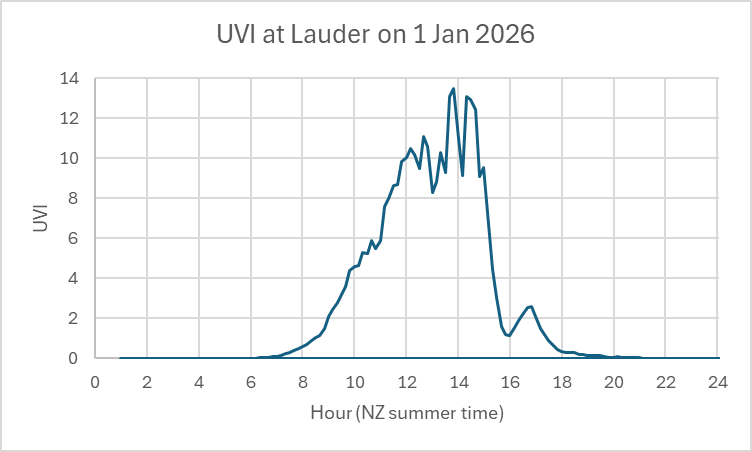
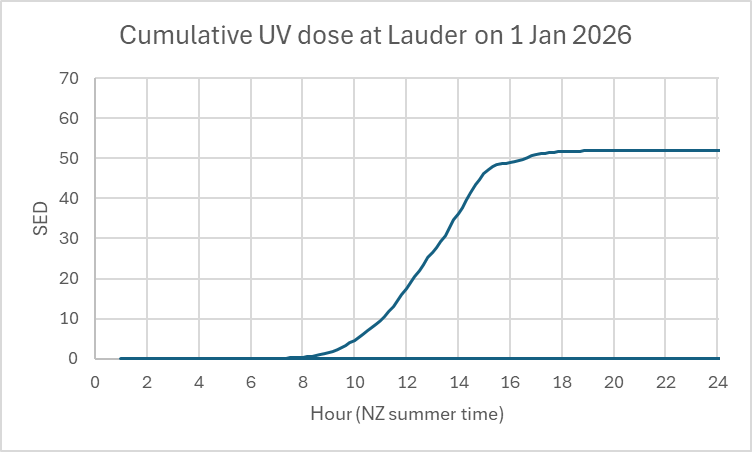
Although the peak UVI was nearly 20 percent greater this day, the daily dose was 25 percent less. By noon, the doses were similar both days, but it clouded over in the afternoon this day. Those highest values are greater than for clear skies because they include radiation scattered from the edges of clouds. Note that all the data shown here are 10-minute means, rather than the hourly means plotted in a previous post. The longer averaging period makes a big difference to the UVI, but little difference to the daily dose.
As a general rule, the largest daily doses of UV tend to occur on cloudless days when the sun is never obscured. On partly cloudy days the sun tends to be obscured some of the time, and if that happens around noon, about half the UV is blocked.